Families across the UK will see an increase in Child Benefit payments starting 7 April 2025, according to HM Revenue and Customs (HMRC).
The updated rates represent a 1.7% rise aligned with inflation, providing valuable financial support to parents during an era of increasing living costs.
What Are the New Child Benefit Rates for 2025?
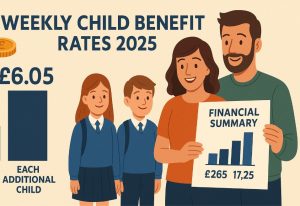
From 7 April 2025, the weekly rate for Child Benefit will increase in line with inflation.
Families in the UK will receive:
- £26.05 per week for the eldest or only child
- £17.25 per week for each additional child
This increase equates to £1,354.60 per year for the first child and £897 per year for each subsequent child. Payments will continue to be made every four weeks directly into a parent or guardian’s bank account.
The following table shows the comparison between the current and upcoming rates:
| Type of Child | 2024 Rate (Weekly) | 2025 Rate (Weekly) | Annual Increase |
| Eldest or only child | £25.60 | £26.05 | £23.40 |
| Additional children | £16.95 | £17.25 | £15.60 |
There is no cap on how many children can be included in a Child Benefit claim. For larger families, this change could result in hundreds of pounds more in total benefits over the course of the year.
When Will the 2025 Child Benefit Increases Take Effect?
The updated rates will officially come into effect on Monday, 7 April 2025. There is no requirement for families with an active claim to take any action to receive the increased payments. HMRC will automatically apply the new amounts to all existing eligible claimants.
For parents expecting their first payment around this time, the increased rates will be included if their claim has been approved and the child is eligible.
It is recommended that new parents submit their claim as soon as possible after the birth of their child.
Why Is Child Benefit Increasing in 2025?

Each year, the government reviews Child Benefit in line with the Consumer Price Index (CPI) to help families keep up with the cost of living.
The 2025 increase reflects a 1.7% rise based on inflation forecasts and economic planning by the Treasury and the Office for Budget Responsibility.
This adjustment is part of the wider strategy to support households managing higher prices in areas such as food, energy and childcare.
It ensures that Child Benefit maintains its real value year-on-year and provides steady financial assistance to families raising children.
Who Is Eligible for the Increased Child Benefit in 2025?
Eligibility for Child Benefit in 2025 remains consistent with existing criteria. Parents and guardians can claim if they are responsible for a child under the age of 16, or under 20 if the child is in full-time education or approved training.
To claim Child Benefit, the following details are typically required:
- Child’s original birth or adoption certificate
- National Insurance numbers for the claimant and their partner (if applicable)
- Bank account details for payment
- Passport or travel documents for children born outside the UK
A claim can only be backdated for up to three months, so prompt action after a birth or adoption is strongly encouraged.
How Do These Increases Affect Low-Income Families?
A Modest Increase with Meaningful Impact
Although the 2025 Child Benefit increase may seem relatively small an extra 45p per week for the first child and 30p for each additional child the added support can still make a noticeable difference for low-income households.
These families often rely on every extra pound to cover the rising costs of living, including food, school supplies, and transport.
For example, a family with three children will receive an additional £54.60 per year compared to 2024, which can contribute toward essentials like uniforms or utility bills.
Why Child Benefit Matters More for Vulnerable Households?
Child Benefit remains a key source of financial assistance for many households that do not qualify for higher-tier benefits or those with inconsistent incomes.
It provides:
- A predictable source of income not affected by employment status
- An automatic payment process that doesn’t require monthly reapplication
- National Insurance credits that support long-term pension eligibility
Many low-income households do not meet the criteria for Universal Credit or are transitioning between work contracts. In such cases, Child Benefit helps bridge the gap and provides a foundation of support.
Additional Support Through Linked Benefits
Receiving Child Benefit can also unlock access to other family assistance programmes:
- Proof of Child Benefit may be required to access free school meals
- Families with young children may qualify for the Healthy Start scheme
- It can be used as a qualifying document for certain local authority grants
For these families, claiming and maintaining Child Benefit is essential not just for the direct payments, but for the gateway it provides to other crucial support systems.
What Are the Payment Thresholds and Tax Implications in 2025?
Revised Thresholds for High-Income Households
As of April 2024, the government has updated the income thresholds for the High Income Child Benefit Charge (HICBC), which will remain applicable in 2025. This charge affects households where one individual earns more than £60,000 per year.
Here’s how the updated threshold structure works:
| Income Bracket | Tax Treatment |
| Below £60,000 | Full Child Benefit retained |
| £60,000 – £70,000 | Partial benefit reclaimed via tax charge |
| £70,000 – £80,000 | Up to 100% of benefit repaid |
| Over £80,000 | Full repayment required |
This tapered charge means the higher your income above £60,000, the more you’ll repay. Once an individual’s income reaches £80,000, the entire benefit is effectively reclaimed via the tax system.
New PAYE Option for Managing the Tax Charge
In response to feedback from working families, HMRC is launching a new optional digital service in summer 2025.
This service will allow those liable for the HICBC to:
- Pay the charge through their PAYE tax code
- Avoid filing a full Self-Assessment tax return
- Monitor payments and charges using the HMRC app
This change aims to simplify tax obligations and reduce the paperwork for employed parents who are affected by the charge.
Considerations for Opting Out or Back In
Families who fall within the charge threshold range often opt out of receiving Child Benefit payments to avoid the administrative burden of tax repayment.
However, opting out doesn’t mean losing the benefit entirely. If a claim is still made even without receiving payments the parent:
- Still accrues National Insurance credits
- Protects their State Pension entitlement
- Remains eligible to opt back in at any time through the HMRC app or GOV.UK
Parents are encouraged to review their current income status annually and decide whether opting in or out provides the most financial advantage.
How Can Families Claim or Update Their Child Benefit in 2025?
Using the HMRC App for Faster Claims and Management
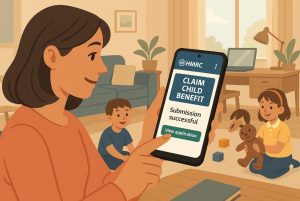
The HMRC app continues to be the fastest and most convenient way for parents and carers to claim and manage Child Benefit in 2025. It’s available for download on both iOS and Android devices and has been significantly improved since its launch.
The app allows users to:
- Submit new claims digitally
- Get real-time status updates and claim confirmations
- Receive payment in as little as three working days after claim approval
Families have used the app more than 6 million times in the last 12 months, with over 1.2 million claims submitted through digital platforms since May 2023.
What You’ll Need to Make a Claim?
To make a new claim, parents or guardians must first create an online account with HMRC.
The following documents and details will be required:
- Your National Insurance number (and your partner’s, if applicable)
- Child’s birth or adoption certificate
- UK bank account details for receiving payments
- Passport or travel documentation for children born abroad
This streamlined process ensures that eligible families can begin receiving Child Benefit quickly and without the need to submit physical forms.
Managing Changes and Updating Information
Parents can also use the HMRC app or the GOV.UK website to manage updates to existing claims.
Key updates include:
- Adding a new child to an existing claim
- Changing bank details or contact information
- Notifying HMRC if the child continues full-time education or enters approved training
- Printing proof of entitlement if needed for other benefits or services
The app now provides immediate digital access to proof of Child Benefit, which can be used when applying for Universal Credit, free school meals, or a travel visa.
Reclaiming After Opting Out
For families who previously opted out of receiving payments, often to avoid the High Income Child Benefit Charge the process of opting back in is straightforward.
Through the app or GOV.UK, users can reinstate payments and manage their preferences without the need to submit a new claim.
This is especially useful in cases where income has changed or where the household is now eligible for full or partial benefits under the revised income thresholds.
What Other Government Supports Are Available for Families in 2025?
Universal Credit and Housing Support
Universal Credit remains one of the most comprehensive benefits available to low-income families in the UK.
It is designed to assist with living expenses, housing costs, and child-related needs. Families can receive additional payments based on:
- Number of children in the household
- Disabilities or special needs
- Housing costs or rent
This benefit is means-tested and is paid monthly, with the amount depending on income, savings, and household composition.
Tax-Free Childcare and Free Childcare Hours
Working parents can also benefit from the Tax-Free Childcare scheme, which contributes 20% toward approved childcare costs. This means families can receive up to:
- £2,000 per year per child under 12
- £4,000 per year per child with a disability under 17
Additionally, eligible working parents of children aged 3 and 4 can access 30 hours of free childcare per week during school terms, helping reduce overall childcare expenses significantly.
Healthy Start Scheme for Young Families
The Healthy Start scheme supports pregnant women and families with children under 4 who are on qualifying benefits. It provides:
- Weekly prepaid card for healthy food and milk
- Access to free vitamins
The card can be used in most major supermarkets and local retailers, making it easier for parents to afford essential nutrition for their children.
Free School Meals and Local Authority Grants
Children from low-income households may be eligible for free school meals during term time, which also makes them eligible for other educational and financial support schemes.
Many local councils also provide Family Support Grants, which may include:
- Help with school uniforms
- Emergency energy assistance
- Vouchers for children’s essentials
Parents should check with their local authority to see what additional support may be available regionally in 2025.
Additional Childcare Support for Working Families
From 2025, further expansions are expected in childcare support. The government has indicated its intention to roll out additional funding and expand eligibility for free nursery hours.
Working parents should watch for updates from their local councils or through GOV.UK for new entitlements or pilot schemes.
Will There Be Future Increases in Child Benefit Beyond 2025?
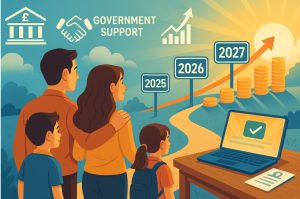
While no specific announcements have been made regarding rates beyond April 2025, it is expected that Child Benefit will continue to increase annually based on inflation.
The government’s current policy supports yearly adjustments that reflect the Consumer Price Index, maintaining the benefit’s relevance and value over time.
Parents and guardians are encouraged to stay informed by checking GOV.UK updates and reviewing their digital HMRC account regularly.
Conclusion: What Does the 2025 Child Benefit Rise Mean for UK Families?
The 2025 Child Benefit rise, though moderate, reflects the government’s recognition of the pressures families face due to inflation and rising living costs.
For millions of households across the UK, this change means additional support that can be easily managed through the HMRC’s modernised digital services.
Claimants are encouraged to review their benefit status, use the app to manage payments, and understand the income thresholds to avoid any unexpected tax liabilities.
FAQs About Child Benefit Increase in 2025
How often is Child Benefit paid in the UK?
Child Benefit is typically paid every four weeks, but single parents or low-income families may request weekly payments.
Can I claim Child Benefit if my child is over 16?
Yes, if your child remains in full-time, non-advanced education or approved training, you may continue to receive payments until they turn 20.
What should I do if my income exceeds £60,000?
You may still claim Child Benefit, but you will need to repay some or all of it through the High Income Child Benefit Charge via Self Assessment or PAYE.
How do I update my child’s education status?
You can notify HMRC via the app or website if your child continues in education beyond age 16, ensuring continued benefit payments.
Is the HMRC app safe for managing Child Benefit?
Yes, the HMRC app is free and secure, and it is now the quickest way to manage or claim Child Benefit, including updates and document submissions.
Can I backdate my Child Benefit claim?
Claims can be backdated up to three months from the date of submission, so apply as soon as possible after your child is born or adopted.
What happens if I opt out of payments but still claim?
You’ll still receive National Insurance credits, which are essential for maintaining your State Pension record, even if you don’t receive payment.
Related Articles: