Carer’s Allowance is a vital benefit in the UK, designed to support individuals who care for someone with a disability or long-term condition.
However, a common question arises: can someone claim this benefit for themselves? Understanding who qualifies and who doesn’t is essential before applying.
This guide explains the eligibility criteria, clarifies misconceptions, and explores alternative support if you are looking after your own needs. Read on to determine whether Carer’s Allowance applies to your situation.
What Is Carer’s Allowance And Who Is It For?

Carer’s Allowance is a government benefit provided to individuals who care for someone with a disability or long-term illness.
It helps ease the financial burden for those who reduce their working hours or stop working entirely to support someone in need. In the UK, the weekly rate is £81.90.
Overview Of Carer’s Allowance In The UK
This benefit supports unpaid carers who provide physical, emotional or practical care to someone receiving a qualifying disability benefit.
The allowance is administered by the Department for Work and Pensions in England, Wales and Northern Ireland, while in Scotland, Carer Support Payment has been introduced gradually as a replacement.
Government Support And Weekly Payment Rates
Carer’s Allowance is not means-tested but is subject to specific conditions, including income limits. It is paid weekly or every four weeks directly into the claimant’s bank account.
Can I Claim Carer’s Allowance For Looking After Myself?
You cannot claim Carer’s Allowance for yourself. The benefit is specifically designed for those who provide care to another person. If you are disabled or need support, you may be eligible for different benefits that help cover your personal care needs.
The Concept Of Self-Care And Benefit Eligibility
Caring for oneself does not fall under the remit of Carer’s Allowance. The government has made it clear that the allowance is for unpaid carers supporting another individual, not for managing one’s own medical or daily needs.
Understanding DWP Guidelines On Self-Care
The Department for Work and Pensions defines a carer as someone who spends time looking after another person who requires regular assistance due to disability. Self-care, while important, is not recognised under the eligibility rules of Carer’s Allowance.
Who Qualifies For Carer’s Allowance Under UK Law?

To qualify for Carer’s Allowance in the UK, both the carer and the person being cared for must meet specific criteria set out by the Department for Work and Pensions (DWP).
These conditions are designed to ensure the benefit goes to individuals providing regular and substantial unpaid care.
The Person You Care For
To be eligible, the person you care for must already receive at least one of the following qualifying disability benefits:
- Personal Independence Payment (PIP): daily living component
- Disability Living Allowance (DLA): middle or highest care rate
- Scottish Adult Disability Living Allowance: middle or highest care rate
- Attendance Allowance
- Pension Age Disability Payment
- Constant Attendance Allowance: at or above the normal maximum rate with an Industrial Injuries Disablement Benefit
- Constant Attendance Allowance: at the basic (full day) rate with a War Disablement Pension
- Armed Forces Independence Payment
- Child Disability Payment: middle or highest care rate
- Adult Disability Payment: daily living component at the standard or enhanced rate
If the person does not receive any of the above benefits, you will not qualify for Carer’s Allowance.
Shared Caring Responsibilities
If another person is already claiming a benefit for caring for the same individual, you may not be eligible. You cannot receive Carer’s Allowance if another carer is already receiving:
- Carer’s Allowance for the same person
- Carer Support Payment (Scotland) for the same person
- The carer element of Universal Credit for the same person
In such cases, it may be possible to agree with the other carer on who should claim. If you apply regardless, the DWP will assess and determine who receives the benefit based on the overall circumstances.
The Type Of Care You Provide
The care you provide must be substantial and regular, amounting to at least 35 hours per week. This care can include:
- Assistance with washing, dressing and personal hygiene
- Preparing meals and helping with feeding
- Managing medication or attending medical appointments
- Carrying out household tasks such as shopping, cleaning and managing finances
The hours can be spread across different days, and they do not need to be continuous. However, they must be verifiable and ongoing.
Your Personal Eligibility
You must also meet a range of individual conditions to qualify:
- Be aged 16 or over
- Provide care for 35 hours or more per week
- Live in England, Scotland or Wales (or abroad as part of the armed forces)
- Have lived in the UK for at least 2 of the past 3 years (exceptions apply for refugees and people with humanitarian protection)
- Not be in full-time education, or studying more than 21 hours per week
- Not be subject to immigration control
- Earn £196 or less per week after deductions
If you live in Scotland, you must apply for Carer Support Payment, the devolved alternative to Carer’s Allowance.
Residency Requirements For EU, EEA And Swiss Nationals
If you are from the EU, Switzerland, Norway, Iceland or Liechtenstein, you and your family will usually need settled or pre-settled status under the EU Settlement Scheme to claim.
While the deadline was 30 June 2021 for most people, some late applications may still be possible depending on circumstances.
Earnings Threshold And What Counts
Your net weekly earnings must not exceed £196 after specific deductions. Income is calculated from employment or self-employment and includes wages after tax, National Insurance and allowable expenses.
Allowable deductions from your income include:
- 50% of any pension contributions
- Essential work-related items like safety clothing or professional equipment
- Unreimbursed travel costs between workplaces
- Business expenses for self-employed individuals
You can also deduct care costs if you pay someone (who is not a close relative) to look after the person you care for or your children while you work. The deduction is capped at 50% of your earnings.
Example Calculation:
If your post-tax income is £100 per week and you spend £60 per week on childcare, you can deduct £50 (50% of your earnings), bringing your net earnings down to £50.
What Counts And Doesn’t Count Toward Earnings Limit?
| Income Type | Counted Toward Limit | Notes |
| Net employment/self-employment income | Yes | After tax, National Insurance and allowable expenses |
| Occupational or private pension | No | Fully excluded from earnings test |
| Living cost contributions from non-tenants | No | Must not be a tenant or boarder |
| Income from a lodger (partial) | Partial | First £20 and 50% of the remainder are excluded |
| Employer loans or advance payments | No | Not treated as income |
| Childcare or care costs paid while working (50% limit) | Partial | Deductible if not paid to close family members |
State Pension And Carer’s Allowance
If you receive State Pension, you cannot receive the full amount of both benefits. If your pension is more than £83.30 per week, you won’t receive Carer’s Allowance directly, but you may still qualify for an increase in Pension Credit.
If your State Pension is less than £83.30 per week, Carer’s Allowance can be used to top up your income to that amount.
If You Are Not Eligible
If you do not qualify for Carer’s Allowance, you may still be eligible for Carer’s Credit. This is a National Insurance credit that helps protect your entitlement to State Pension without any financial payment.
It is available to those who provide care but fall outside the income or other eligibility thresholds.
What If I Am Caring For Someone Else But Also Have My Own Health Issues?

It is possible to be both a carer and someone who receives disability benefits. The key requirement is that you must be providing care for another individual, even if you are receiving support for your own health.
Dual Role As A Carer And A Person With A Disability
Many people in the UK care for someone else while also living with a disability themselves. If you provide 35 hours of care per week and meet the earnings limit, you can still receive Carer’s Allowance even if you receive PIP or other personal benefits.
Claiming Other Benefits Alongside Carer’s Allowance
You may still be eligible for:
- Universal Credit with a carer element
- Pension Credit increases
- Employment and Support Allowance (with certain conditions)
How Do I Apply For Carer’s Allowance In The UK?
Applications can be completed online or through a paper form. The application process is designed to gather full details of your caring responsibilities and income.
Online And Paper Application Methods
You can apply via the official government website or request a paper form from your local Jobcentre Plus. Online applications tend to be quicker and allow for easier document uploads.
Required Documentation And Timelines
You will need to provide:
- Your National Insurance number
- The National Insurance number of the person you care for
- Details about your earnings and employment
- A description of the care you provide
Applications are usually processed within 6 weeks. You can request backdated payments of up to three months if you meet the eligibility criteria during that time.
What Happens If I’m Not Eligible For Carer’s Allowance?
If you are not eligible, alternative forms of support are available, especially if you still perform caring duties or need help with your own daily activities.
Alternative Benefits And Support Options
You may consider:
- Carer’s Credit, which helps protect your State Pension entitlement
- Universal Credit with a carer element
- Attendance Allowance or PIP for your personal needs
- Local authority assessments and support plans
Local Authority Support And Other Financial Aid
Your local council can offer:
- Carer assessments
- Respite care
- Help with transport or household modifications
Can I Claim Other Benefits While Receiving Carer’s Allowance?

Carer’s Allowance may reduce the value of other benefits due to overlapping rules, but in many cases, it can still be claimed in combination with others.
Impact On Universal Credit, Pension Credit And Income Support
You may be entitled to:
- A carer element in Universal Credit
- Increases in Pension Credit if State Pension overlaps with Carer’s Allowance
- Income Support supplements
Benefit Overlaps And Benefit Cap Considerations
Carer’s Allowance does not exempt you from the benefit cap. However, claiming other allowances such as PIP or working tax credits may help you avoid benefit reductions.
How Does Carer’s Allowance Affect Taxes And Other Entitlements?
Carer’s Allowance is a taxable benefit and may affect your overall tax situation depending on your total income.
Impact On Your National Insurance Record
Receiving Carer’s Allowance can provide National Insurance credits which count toward your State Pension eligibility.
Income Tax Implications And Reporting Responsibilities
You must report the income to HMRC if your total earnings, including Carer’s Allowance, exceed the personal allowance. This may result in additional tax liability.
How Is Carer’s Allowance Paid And Managed?
Payments are made weekly or every four weeks directly into a bank account. You must keep your details updated with DWP if your situation changes.
Weekly Payments And Banking Options
You can choose between:
- Weekly payments in advance
- Monthly or four-weekly payments
What To Do If Circumstances Change?
You must notify DWP if:
- You stop providing care
- Your income exceeds £196 a week
- You begin full-time education
- The person you care for is no longer eligible
What Are The Most Common Misconceptions About Claiming Carer’s Allowance?
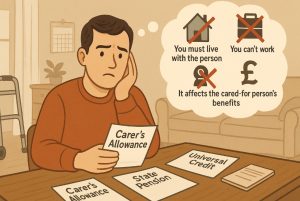
Misunderstandings around Carer’s Allowance can result in misinformed applications or unnecessary rejections.
Self-Care Vs Caring For Another Person
A frequent misconception is that you can receive the allowance for looking after yourself. This is not permitted. The care must be directed toward another person who qualifies.
Myths Around Part-Time Work And Earnings Limits
You can still work part-time and claim the allowance as long as your net weekly income does not exceed the limit. Deductions are permitted for certain expenses, including:
- 50% of pension contributions
- Equipment or clothing required for work
- Travel between job sites
Below is a helpful summary of how earnings are treated:
What Counts Toward The £196 Earnings Limit?
| Earnings Type | Counted Towards Limit | Notes |
| Net employment/self-employment income | Yes | After tax, NI and allowed expenses |
| Pension income | No | Private and occupational pensions are not counted |
| Income from a lodger (partial) | Partial | First £20 and 50% of the remainder excluded |
| Employer advances or loans | No | Not considered as income |
| Reimbursed expenses for care while working | Partial | Up to 50% of earnings if not paid to relatives or household members |
Comparison Of Carer’s Allowance And Alternative Benefits
| Feature | Carer’s Allowance | PIP | Attendance Allowance | Universal Credit |
| For Self-Care | No | Yes | Yes | Yes |
| Requires Caring For Someone Else | Yes | No | No | Yes |
| Weekly Payment | £81.90 | £26.90–£172.75 | £72.65–£108.55 | Varies |
| Affects Other Benefits | Yes | Yes | Yes | Yes |
| Taxable | Yes | No | No | Partially |
Conclusion: What should I consider before applying for Carer’s Allowance?
Before applying, it’s crucial to understand that Carer’s Allowance is strictly for those providing substantial care to someone else.
If you’re seeking support for managing your own health, other benefits like PIP, Attendance Allowance, or Universal Credit may be more appropriate.
Always check the latest DWP guidelines or speak to a benefits adviser to explore your options fully.
FAQs About Carer’s Allowance and Self-Claims
Can someone with a disability claim Carer’s Allowance for themselves?
No, Carer’s Allowance is for individuals who provide care to others, not themselves. Disabled individuals should consider PIP or Attendance Allowance.
What is the definition of a carer according to UK benefits?
A carer is someone who spends at least 35 hours a week providing unpaid care to another person with qualifying benefits.
Can I be paid to care for myself if I live alone?
No, UK benefit rules do not allow payment for self-care, regardless of living arrangements.
Can I still receive benefits if I don’t qualify for Carer’s Allowance?
Yes. You may qualify for Carer’s Credit, Universal Credit, or other disability-related benefits.
What if I care for multiple people does that increase the allowance?
No, you can only claim one Carer’s Allowance payment even if you care for more than one person.
Is Carer’s Allowance means-tested in the UK?
It is not fully means-tested, but your earnings must not exceed the weekly limit after deductions.
How soon after applying will I know if I’m eligible?
Most applications are processed within 6 weeks. You may receive backdated payments if eligible from an earlier date.
Related Articles: