Understanding state pension systems is crucial for those planning retirement, especially in countries with different economic structures and social welfare priorities.
France and the United Kingdom both offer state pensions, but the amounts, eligibility requirements, and overall systems vary significantly.
This article explores how much the state pension is in France compared to the UK, offering insight into what retirees can expect in each country.
What Is The Current State Pension Amount In France?

The French state pension system operates on a pay-as-you-go basis, meaning current workers’ contributions fund the pensions of retirees.
On average, a French retiree receives about €1,500 per month, although this can vary widely.
The pension amount is influenced by:
- Length of insurance: Workers need to contribute for a minimum number of years to qualify for a full pension. For individuals born in 1973 or later, this will rise to 43 years by 2035.
- Average earnings: The pension is calculated based on the average of the 25 highest-earning years.
- Contribution method: Based on a shared responsibility between employees and employers.
- Pension ceiling: The maximum state pension is capped at 50% of the social security salary ceiling, which currently equates to around €1,833 per month.
- Minimum pension: Low-income workers with full contribution periods may qualify for a minimum payment of approximately €684 per month, while the guaranteed minimum income is about €1,200 per month.
France also offers prorated pensions to those with at least 10 years of contributions, and retirees who haven’t met the full qualifying period receive proportionally lower benefits.
A significant gender disparity exists within the system. On average, women receive lower pensions than men, often due to career interruptions or part-time work, which affect both contribution periods and total earnings used in pension calculations.
How Does The UK State Pension Work In Comparison?
The UK offers a flat-rate State Pension system, which is not dependent on an individual’s income but on the number of National Insurance (NI) qualifying years.
In the 2025–26 tax year, the full new State Pension is £230.25 per week, which equals roughly £921 per month or £11,972 per year.
Individuals may receive less or more than this depending on their contribution history and whether they qualified for additional entitlements before 2016.
Key influencing factors include:
- Number of qualifying years: 35 years of NI contributions are required for the full pension.
- Contracted-out status: Those who were contracted out before 2016 may need more years to qualify for the full amount.
- Protected payment: Individuals entitled to more under the old system receive a top-up above the flat rate.
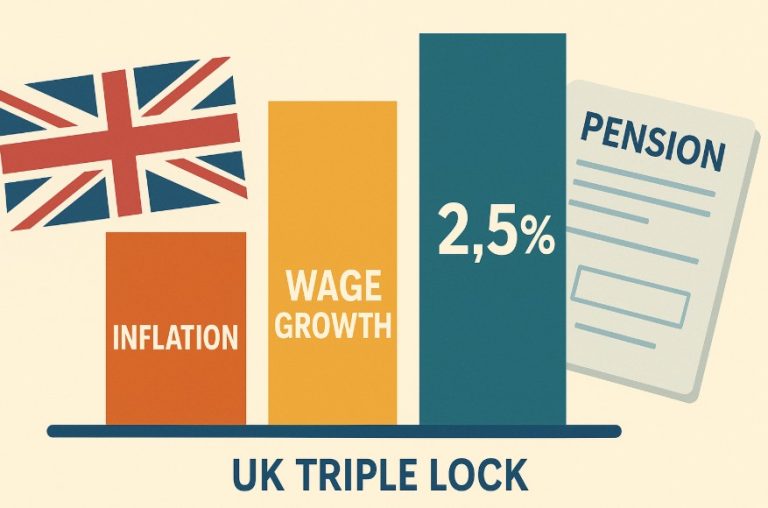
The UK operates a Triple Lock Guarantee, ensuring the State Pension increases each year by the highest of:
- Average earnings growth
- Consumer Price Index (CPI) inflation
- 2.5%
UK State Pension Breakdown (2025–26)
| Pension Type | Weekly Amount | Monthly Equivalent | Annual Total |
| Full New State Pension | £230.25 | ~£921 | ~£11,972 |
| Less Than Full Pension | Based on years | Varies | Varies |
| With Protected Payment | Above £230.25 | Varies | Varies |
Pensions are taxable, though most retirees fall within the personal allowance and may pay little or no income tax on their pension.
What Are The Retirement Ages In France And The UK?

France
- The legal retirement age in France is currently 64, following the 2023 reforms.
- However, to qualify for a full pension, individuals must meet the minimum contribution period, which will rise to 43 years by 2035 for those born in or after 1973.
United Kingdom
- The State Pension age is 66, with scheduled increases:
- Rising to 67 by 2028
- Expected to rise to 68 in the following years, depending on date of birth and future legislation
The UK does not allow early access to the State Pension before reaching the minimum age.
In France, early retirement is possible in some circumstances, such as disability or long careers, but may result in reduced pension amounts.
How Do Pension Contributions Differ Between The Two Countries?
Contributions in both countries are mandatory but structured differently. France relies more heavily on an earnings-related contribution system, whereas the UK bases contributions on set thresholds.
Comparison Of Pension Contributions
| Criteria | France | United Kingdom |
| Employee Contributions | 7% to 10% of gross salary | 12% of earnings above threshold |
| Employer Contributions | 15% to 20% of employee’s gross salary | 13.8% of employee’s earnings |
| Contribution Basis | Gross income | National Insurance categories |
| Supplementary Schemes | Mandatory (e.g. AGIRC-ARRCO) | Optional (e.g. workplace, private) |
In France, workers are automatically enrolled into supplementary pension schemes, which significantly increase retirement income.
In contrast, the UK encourages voluntary contributions into private or occupational pensions, typically through auto-enrolment.
How Much State Pension Do Retirees Actually Receive On Average?
While statutory rates offer a guideline, the actual pension received varies depending on the individual’s contribution history and earnings.
Average Monthly Pension Amounts
| Country | Average Monthly Pension | Minimum Pension | Maximum Pension (State) |
| France | ~€1,500 | ~€684 | ~€1,833 |
| United Kingdom | ~£921 | ~£600 (less than full) | ~£921 + protected payment |
In France, the higher average reflects the earnings-linked structure and long contribution requirements. In the UK, although the flat rate simplifies the system, many pensioners receive less than the full amount due to gaps in their NI record or being contracted out.
How Do Cost Of Living And Taxation Affect Pension Value?

Cost Of Living Considerations
- France has higher average costs for housing and groceries but lower healthcare costs due to a state-funded healthcare system.
- The UK may present more affordable housing in certain regions, but retirees could face rising expenses in energy bills and social care.
Taxation Of Pensions
- In France, pensions are considered taxable income and may also incur social charges depending on the pensioner’s overall income.
- In the UK, the State Pension is also taxable. However, many pensioners fall under the personal allowance threshold, which is £12,570 as of 2025, meaning they may not pay any income tax on their pension alone.
Purchasing Power Impact
Although the French pension may seem higher in raw figures, the net value after taxation and living expenses can narrow the gap between the two countries.
Exchange rates, inflation, and healthcare needs also affect the real value of pensions for expats and domestic retirees alike.
Which Country Offers a Better Pension System Overall?
According to international comparisons and indices like the Mercer Global Pension Index and OECD reports:
- France ranks higher for retirement income adequacy.
- The UK scores well in sustainability and governance, but lags in pension adequacy.
Key strengths:
| Feature | France | UK |
| Higher average pension | Yes | Lower flat rate |
| Sustainability | Under pressure due to ageing population | Relatively sustainable |
| Flexibility | Limited early retirement options | More private pension flexibility |
| Inflation protection | Annual increases tied to inflation | Triple lock mechanism |
What Should UK Expats Know About Receiving Pensions in France?
Brexit has introduced complexities, but pensions remain largely portable between the UK and France.
Key considerations:
- Existing agreements between the UK and EU ensure pension contributions from both countries are acknowledged when calculating entitlements.
- UK State Pension can still be claimed abroad, and annual increases are applied in France due to the reciprocal agreement.
- Currency exchange rates can affect income consistency.
- Double taxation agreements help prevent being taxed in both countries.
It’s important for UK nationals living in France to register their UK pension with HMRC and consult with a cross-border financial adviser.
Which Country Provides Greater Pension Stability And Long-Term Sustainability?
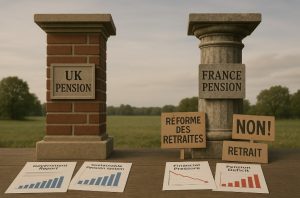
When comparing France and the UK, pension stability is increasingly influenced by demographics, economic policy, and workforce dynamics. Both nations face mounting challenges due to ageing populations, but they approach these challenges differently.
France’s Pension Stability
France operates on a pay-as-you-go system, where today’s workers fund current retirees. This model is under pressure as the ratio of workers to pensioners declines.
The French government has responded with reforms such as raising the retirement age from 62 to 64 in 2023, with further increases in contribution periods planned.
However, the system still faces sustainability concerns:
- France has a high dependency ratio, with fewer contributors supporting more retirees.
- The pension system relies heavily on government subsidies, increasing fiscal strain.
- Ongoing political resistance to reform makes long-term changes challenging to implement.
UK’s Pension Stability
The UK model is considered more sustainable due to its flat-rate structure and reliance on pre-funded workplace and private pensions alongside the State Pension.
The introduction of auto-enrolment has encouraged millions to save for retirement, reducing dependence on the state.
Key points supporting UK sustainability:
- The UK State Pension is less generous but more affordable for the government.
- Annual increases are managed through the Triple Lock, providing long-term predictability.
- The system allows flexibility through private contributions and later retirement options.
In summary, the UK offers a more fiscally sustainable pension framework, while France’s system provides higher benefits but with greater risk of future funding gaps unless continued reforms are adopted.
What Are The Key Considerations For British Expats Retiring In France?
For British citizens considering retirement in France, understanding the interaction between UK and French pension systems is essential. Although pensions are portable, Brexit and local regulations have introduced additional considerations.
Receiving UK Pensions In France
UK expats can claim their UK State Pension while living in France. Thanks to ongoing bilateral agreements, pensions paid to UK nationals in France still receive annual increases, unlike those in some other non-EU countries.
Key points to note:
- You’ll need to inform HMRC of your overseas address and provide a valid French bank account or use international transfer services.
- The State Pension is paid in GBP, but conversion to euros may affect income due to currency fluctuations.
- A Double Taxation Agreement exists, meaning you generally won’t be taxed on your UK pension in both countries.
French Pension Eligibility
British citizens who have worked in France may qualify for a French state pension, provided they meet the minimum 10-year contribution requirement. Contributions made in the UK and France can often be aggregated under EU coordination rules to meet eligibility thresholds.
Additional Considerations
- Access to healthcare in France may require joining the PUMA system or holding private insurance until eligible.
- Estate planning and inheritance laws in France differ significantly from the UK.
- Exchange rate volatility can affect monthly pension income.
Careful financial planning and seeking advice from cross-border pension specialists are recommended to maximise retirement income and ensure compliance with local regulations.
Conclusion
The French state pension provides higher average payments but demands a longer contribution period and is tied closely to earnings. Meanwhile, the UK state pension is simpler, easier to calculate, and more sustainable, though less generous.
For British residents or expats, understanding both systems is key to effective retirement planning. Individuals should explore private pensions and savings options to supplement state pensions, regardless of their country of residence.
Frequently Asked Questions (FAQs)
What is the minimum contribution period to get a French pension?
You must contribute for at least 10 years (or 43 years for a full pension by 2035) to qualify for a prorated state pension in France.
Can UK citizens receive a state pension while living in France?
Yes, the UK State Pension can be paid to residents in France, and it includes annual increases due to international agreements.
How often do French pensions increase?
French pensions are typically adjusted annually, based on inflation rates, though changes may vary with policy shifts.
Do UK state pensions increase every year?
Yes, under the triple lock system, UK pensions increase annually by the highest of wage growth, inflation (CPI), or 2.5%.
Is it better to retire in France or the UK for pension value?
It depends on factors such as lifestyle, healthcare needs, and tax preferences. France offers higher pensions, but the cost of living and healthcare access must also be considered.
What is a protected payment in the UK pension system?
A protected payment is an additional amount paid on top of the new State Pension for those who had entitlement to more under the old system.
Are private pensions popular in France like in the UK?
Not to the same extent. In France, mandatory supplementary pensions cover much of what private pensions do in the UK.