Parking restrictions across the UK can be challenging, especially for those with mobility difficulties.
The Blue Badge scheme aims to ease this by offering certain exemptions, but many still wonder: can you park on double yellow lines with a Blue Badge? Understanding where and when these rules apply is essential to avoid fines and ensure safe, lawful parking.
This guide explains the key rules, responsibilities, and exceptions every Blue Badge holder should know.
What Are the Rules for Parking on Double Yellow Lines With a Blue Badge?
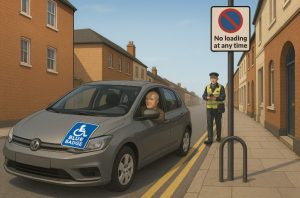
Blue Badge holders are entitled to specific on-street parking concessions to assist with mobility. One of the main questions people have is about parking on double yellow lines.
In general, double yellow lines indicate a restriction on parking at any time.
However, Blue Badge holders are permitted to park on double yellow lines for up to three hours, provided there are no loading or unloading restrictions in force.
These restrictions are usually indicated by yellow markings on the kerb and accompanying signage.
If such restrictions are in place, parking is not allowed, even with a Blue Badge. Parking must also not obstruct traffic, pedestrian routes or create safety hazards.
It is important to remember that the Blue Badge scheme applies only to on-street parking and does not automatically grant concessions in private car parks, shopping centres, or hospital grounds unless local rules provide such allowances.
How Long Can You Park on Double Yellow Lines With a Blue Badge?
When parking on double yellow lines, a Blue Badge holder must follow the three-hour time limit set by the scheme.
This rule is designed to allow fair access to parking for all eligible individuals while ensuring that the vehicle does not cause an obstruction or overstay in a restricted zone.
The following rules must be followed:
- Display the Blue Badge clearly on the dashboard with the hologram facing upwards
- Set and display the parking clock to the time of arrival
- Leave at least one hour before returning to park in the same spot
Failing to comply with these requirements may lead to a Penalty Charge Notice (PCN).
Where Else Can Blue Badge Holders Park Legally?
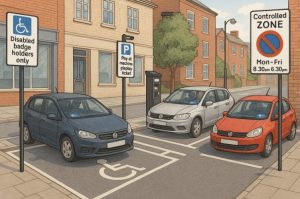
The Blue Badge scheme provides valuable on-street parking concessions to help people with mobility impairments park closer to their destination.
While much attention is given to parking on yellow lines, Blue Badge holders are entitled to several other legal parking options that can significantly enhance their convenience and access provided they follow the local rules.
Blue Badge holders may park in various on-street parking spaces that are typically time-restricted or metered for the general public. These concessions are available across most local authorities in England, although specific details may vary depending on the area.
Some of the most commonly accessible areas for Blue Badge holders include:
- Pay-and-display bays: Blue Badge holders can usually park free of charge and without a time limit. However, local signage should always be checked in case there are exceptions or limitations.
- Parking meters: On-street parking meters often allow badge holders to park free of charge. Again, signage will confirm whether any time restrictions apply.
- Disabled parking bays (on-street): These bays are specifically reserved for Blue Badge holders and are marked by the blue wheelchair symbol. In most cases, there is no time limit unless signs indicate otherwise.
- Limited-time free parking zones: In areas where all drivers can park for free but only for a short period, Blue Badge holders may stay longer, sometimes without time restriction. However, if signage shows a limit also applies to Blue Badge holders, this must be followed, and the parking clock must be used.
- Controlled Parking Zones (CPZs): Many CPZs allow Blue Badge holders to park without a resident permit or pay-and-display ticket, although local rules should always be reviewed.
Below is a detailed table outlining common parking situations and the general guidance for Blue Badge holders:
| Location Type | Blue Badge Concession | Requirement |
| On-street pay-and-display bays | Free parking, often with no time limit | Must display Blue Badge |
| On-street parking meters | Free parking | Must display Blue Badge |
| Disabled parking bays (on-street) | Free parking; may have time limits | Display badge and clock if required |
| Single or double yellow lines | Up to 3 hours where no loading restrictions apply | Display badge and parking clock |
| Controlled Parking Zones (CPZs) | Generally allowed to park without paying | Check local authority signage |
| Limited-time bays (free for all) | Extended or unlimited parking | Follow signage and use clock if applicable |
These parking concessions apply to on-street parking only. Blue Badge holders do not automatically receive the same rights in off-street car parks such as those operated by private businesses, hospitals, supermarkets, or shopping centres.
In these locations, the decision to offer free or extended parking is entirely up to the site owner or operator, and terms vary significantly.
In areas with local schemes or additional restrictions, such as certain boroughs in central London, further requirements may apply. Blue Badge holders might need to register in advance for separate exemptions or permits in these boroughs.
To avoid misunderstandings or fines, Blue Badge holders should always:
- Check local signs when parking
- Look for bay markings, kerbside indicators, or nearby information plates
- Follow time restrictions where applicable
- Display both the badge and clock when required
By understanding the full range of places where they can legally park, Blue Badge holders can enjoy greater independence while avoiding unnecessary penalties or enforcement actions.
Are There Any Places Where Blue Badge Parking Is Not Allowed?
Although the Blue Badge offers valuable concessions, it does not permit parking in all locations. Badge holders must continue to follow general road safety rules and restrictions.
Parking is not allowed in the following areas:
- Loading bays where loading restrictions are active, usually marked by yellow kerb dashes
- Resident permit holder bays, unless the local council allows Blue Badge parking
- Clearways or urban clearways during operational hours
- Bus stops or cycle lanes where stopping is not permitted
- Pedestrian crossing zig-zag areas
- Private roads or car parks without prior permission
- Areas marked with double white lines in the centre of the road
- Suspended parking bays or areas with temporary restrictions
The badge does not exempt the user from traffic regulations or allow them to park dangerously. Misuse of parking privileges may result in fines or confiscation of the badge.
What Are the Rules for Displaying a Blue Badge Correctly?
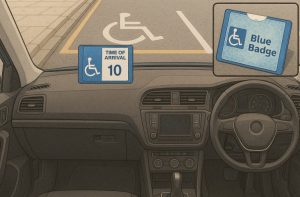
Displaying a Blue Badge correctly is essential to ensure that the parking concessions it provides are valid. Improper display can result in a Penalty Charge Notice (PCN) or the badge being confiscated. Enforcement officers are trained to inspect badges and issue fines when display rules are not followed.
To avoid penalties, it’s important to understand exactly how and where the badge should be placed, what should be visible, and when the parking clock is required.
Where Should the Badge Be Placed?
The Blue Badge must be placed in a location that is easily visible through the front windscreen of the vehicle. Specifically, it should be:
- Positioned on the dashboard or facia panel
- Clearly displayed without being covered by any objects
- In a location that makes it easy for enforcement officers to read from outside the vehicle
If your vehicle does not have a dashboard or facia panel, the badge must still be displayed in a place where it is visible from outside the vehicle. The key requirement is that the information on the front of the badge can be easily read.
What Side of the Badge Should Be Visible?
The correct side of the badge to display is the front the side with the hologram and the expiry date. The side showing the holder’s photograph must always be kept hidden from view.
If the badge is placed with the photo side up, it may be treated as not properly displayed, which could result in a parking fine.
What Happens if the Badge Becomes Illegible?
Over time, badges may suffer wear and tear, causing the details to become faded or unreadable. In such cases:
- You must contact your local council and request a replacement badge
- Do not continue to use a badge that is damaged or illegible
- Continuing to display a worn-out badge may result in a Penalty Charge Notice
It is the badge holder’s responsibility to ensure that the badge remains in a legible and usable condition at all times.
When Should the Parking Clock Be Used?
The blue parking clock is issued alongside the Blue Badge and must be displayed in addition to the badge in certain parking situations. Specifically, the clock is required when:
- Parking on single or double yellow lines, where the maximum stay is 3 hours
- Using time-limited disabled bays that specify a maximum parking duration
The clock must be set to the quarter-hour period during which the vehicle arrived and placed on the dashboard next to the badge so it can be clearly read through the windscreen.
Failure to display the clock where it is required may result in enforcement action.
What Should Blind or Visually Impaired Badge Holders Do?
For badge holders who are blind or visually impaired, it is essential that the person assisting with travel whether a friend, family member, or carer understands the display rules thoroughly. This includes:
- How to position the badge correctly
- When to use the parking clock
- Ensuring both are fully visible through the windscreen
If the badge or clock is not displayed correctly, enforcement officers will not consider disability status as a mitigating factor, and fines can still be issued.
Who Has the Authority to Inspect the Badge?
The badge must be shown upon request to any of the following:
- Police officers
- Traffic wardens
- Civil Enforcement Officers
- Parking attendants
These officials have the power to inspect the badge at any time when it is in use. Civil Enforcement Officers may even be in plain clothes and must provide identification if asked.
If there are reasonable grounds to suspect misuse or a breach of display rules, they can legally retain the badge on the spot.
Failure to present the badge when requested, or refusal to cooperate, may result in a fine of up to £1,000.
Summary of Correct Display Rules
To help ensure full compliance, here is a quick reference checklist for displaying your badge:
| Requirement | Details |
| Badge Placement | On dashboard or facia panel, visible through windscreen |
| Side to Display | Front side with hologram and expiry date |
| Photo Side | Must always be hidden |
| Parking Clock Requirement | Needed on yellow lines and in time-limited bays |
| Clock Time Setting | Set to the quarter-hour of arrival |
| Badge Condition | Must be clean, legible, and undamaged |
| Officer Inspection | Must be shown to authorised officers when requested |
Correct badge use not only ensures lawful parking but also protects the integrity of the Blue Badge scheme, allowing it to continue serving those who genuinely need it.
Can You Get a Fine for Parking With a Blue Badge?
Although the Blue Badge offers considerable parking concessions, improper use can lead to enforcement measures. Common reasons for fines include:
- Parking in restricted zones where loading or stopping is prohibited
- Failing to display the badge or clock correctly
- Exceeding the permitted three-hour limit on yellow lines
- Using an expired, copied, or altered badge
- Letting someone else use the badge without the badge holder being present
Civil Enforcement Officers, traffic wardens, or police officers may ask to inspect the badge and, if there are reasonable grounds, can retain it on the spot.
Fines for misuse may reach up to £1,000, and councils have the authority to withdraw the badge altogether.
What Should You Know About Local Authority Parking Enforcement?
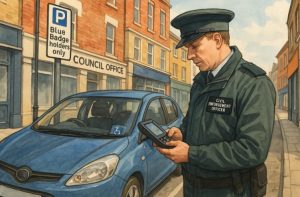
Enforcement of Blue Badge regulations varies slightly across different local councils. While the overall scheme is standardised throughout England, local authorities can impose specific rules, particularly in urban centres.
Some London boroughs operate their own schemes and do not fully participate in the national Blue Badge system.
These include the City of London, Westminster, Camden, and Kensington & Chelsea. Blue Badge holders must apply for local permits or follow different procedures to park in these areas.
Civil Enforcement Officers have the power to inspect and retain badges without police presence. They are permitted to operate in plain clothes and must show valid identification if they request to examine a badge.
What Happens if Someone Misuses a Blue Badge?
Blue Badge misuse is considered a criminal offence and can result in penalties. The badge is intended only for use when the holder is present in the vehicle, either as a passenger or driver. It must not be lent to others for any purpose.
The badge remains the property of the issuing local authority and must be returned in situations such as:
- When it has expired
- When no longer needed due to improved mobility
- If it becomes damaged or illegible
- If the badge holder has passed away
Failure to return a badge in these circumstances or using it fraudulently may lead to a fine or prosecution.
Local authorities have a legal responsibility to enforce the scheme strictly to prevent misuse and preserve access for genuine users.
How Does the Blue Badge Scheme Support Disabled Drivers?
The scheme is designed to support disabled individuals who face serious difficulties in mobility.
It allows them to access areas that might otherwise be off-limits or too far to reach easily. This includes parking closer to shops, medical facilities, public buildings, and other destinations.
Blue Badge holders are entitled to:
- Park closer to their destination, on-street
- Benefit from extended parking time limits
- Access parking zones where general parking is restricted
However, with these benefits come responsibilities. The badge should only be used when the holder is in the vehicle and for their direct benefit. Abuse of the scheme undermines its integrity and restricts availability for those who genuinely rely on it.
When Should You Avoid Parking on Double Yellow Lines, Even With a Badge?
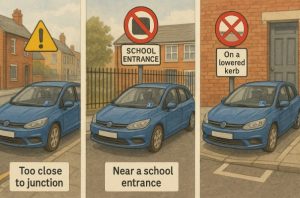
Even where parking is legally permitted, there are circumstances where Blue Badge holders should avoid stopping. Situational awareness and consideration for others are essential.
Examples where caution is advised include:
- Near school entrances where children cross frequently
- Close to junctions or where visibility is restricted
- In front of driveways or emergency access points
- On pavements unless signs specifically allow it
- Where it could obstruct wheelchair ramps or lowered kerbs
The Highway Code still applies, and enforcement officers may issue fines or remove vehicles if parked dangerously or inconsiderately.
Below is a second table highlighting situations where Blue Badge parking should be avoided:
| Location or Situation | Reason to Avoid Parking |
| Within 10 metres of a junction | Obstructs visibility and flow of traffic |
| Opposite a traffic island or roadworks | Reduces road width and impedes traffic |
| Near a hospital entrance or emergency zone | Blocks emergency access routes |
| On a hill or sharp bend | Creates blind spots and increases accident risk |
| Across a dropped kerb or wheelchair access | Inhibits pedestrian movement |
Understanding when not to park is as crucial as knowing where parking is allowed. It ensures safety, accessibility and compliance with the law.
Conclusion
The Blue Badge offers vital parking concessions, but it doesn’t permit unrestricted access everywhere. Knowing the limits such as time restrictions on double yellow lines and areas where parking remains prohibited, is key to using the badge correctly.
Responsible use not only ensures compliance with the law but also helps maintain the integrity of the scheme for all users. Always display your badge properly, check local signage, and consult your local authority for specific rules when in doubt.
Frequently Asked Questions
What is the maximum time I can park on double yellow lines with a Blue Badge?
Blue Badge holders can park for up to three hours on double yellow lines, as long as there are no loading restrictions.
Can I use my Blue Badge in private car parks?
No, the scheme applies only to on-street parking. Private car park rules are determined by the owners.
Do I need to use the parking clock every time?
You must use the blue parking clock when parking in areas with time restrictions, such as yellow lines or time-limited bays.
What happens if my badge becomes damaged or faded?
If your badge becomes illegible, return it to your local council to request a replacement.
Can someone else use my badge if they’re helping me?
Only if you are being transported in the vehicle at the time. Letting others use the badge alone is misuse and illegal.
Are there restrictions in central London?
Yes, several boroughs have local schemes. Always check with the local authority before parking in Westminster, Camden, or Kensington & Chelsea.
Can I park abroad with my Blue Badge?
Some EU countries and Switzerland accept the UK Blue Badge. Check local rules before travelling.