Last checked: 30 June 2026
Editorial note: This article was checked against current GOV.UK State Pension, Pension Credit, claiming and deferral guidance.
Disclaimer: This information is general guidance and is not personalised financial, tax, legal or pension advice. Individual State Pension entitlement depends on a person’s National Insurance record and circumstances.a
There is no standard Department for Work and Pensions payment that gives every eligible pensioner £649 a week. For the 2026/27 tax year, the full new State Pension is £241.30 a week, while the full basic State Pension is £184.90 a week.
Some people can receive more than the headline full rate because of protected payments, Additional State Pension, inherited entitlement or increases earned by delaying their claim.
However, £649 is not an official flat rate, a newly announced payment or a published maximum available to all pensioners.
DWP £649 State Pension: Key Facts
- Full new State Pension: £241.30 a week in 2026/27
- Full basic State Pension: £184.90 a week in 2026/27
- Minimum National Insurance record: Normally 10 qualifying years for any new State Pension
- Full-rate requirement: Normally 35 qualifying years when the National Insurance record began after April 2016
- Claims: State Pension is not paid automatically and must be claimed
- £649 figure: Not an official standard State Pension rate or universal DWP payment
Why Are People Searching for a £649 State Pension?

The £649 figure appears in online headlines and social-media discussions, but it does not appear in the official 2026/27 State Pension rate tables as a standard weekly payment.
One possible source of confusion is that the full State Pension rate is not necessarily the highest amount an individual can receive.
Some pensioners receive more than the standard rate because their award includes one or more of the following:
- A protected payment under the transitional new State Pension rules
- Additional State Pension built up under the previous system
- An inherited amount from a spouse or civil partner
- Extra State Pension earned by delaying or deferring a claim
Therefore, a high individual payment should not be interpreted as evidence that every pensioner has become entitled to £649 a week.
There is also no verified evidence that “DWP 649” is the official name of a new scheme, claim form or payment. Any article making that claim should provide a direct GOV.UK announcement, legislation or DWP publication rather than relying on an unattributed screenshot or social-media post.
Could Someone Actually Receive £649 a Week?
It may be possible for an individual pensioner to receive an unusually high weekly amount, but that does not make £649 an official standard rate.
A person’s award may be higher than the full new State Pension if they have a protected payment or qualifying entitlement under the former Additional State Pension system. Deferring a State Pension can also increase regular payments.
For people who reached State Pension age on or after 6 April 2016, deferral normally adds 1% for every nine weeks that the pension remains unclaimed. This is equivalent to just under 5.8% for every complete year of deferral.
Reaching a weekly amount close to £649 through deferral alone would normally require an exceptionally long delay and would depend on the person’s starting entitlement, applicable pension rules and annual uprating. It should therefore be described as an unusual individual outcome not a new DWP payment or a maximum entitlement.
Anyone who has received a letter showing an unexpected amount should contact the Pension Service using contact information found independently on GOV.UK. A number printed on a letter should not automatically be treated as either a payment amount or an official scheme name.
What Are the State Pension Rates for 2026/27?
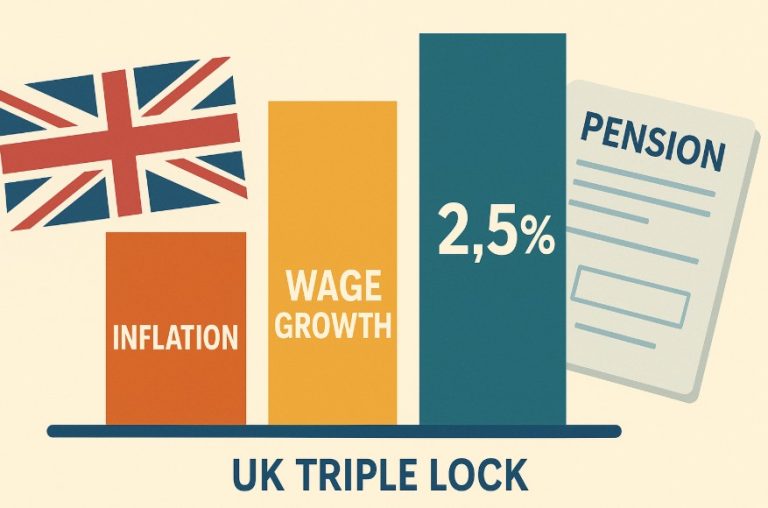
State Pension rates increased by 4.8% from April 2026 under the triple-lock calculation.
| Pension type | 2025/26 weekly rate | 2026/27 weekly rate | Approximate annual amount |
| Full new State Pension | £230.25 | £241.30 | £12,547.60 |
| Full basic State Pension | £176.45 | £184.90 | £9,614.80 |
These are full standard rates. The amount actually paid to an individual may be lower or higher depending on their National Insurance history, transitional calculation, Additional State Pension, protected payment, inherited entitlement and any deferral increase.
The new State Pension generally applies to men born on or after 6 April 1951 and women born on or after 6 April 1953. People who reached State Pension age under the previous system may receive the basic State Pension together with Additional State Pension or other inherited amounts.
How Is an Individual State Pension Amount Calculated?

The full new State Pension is £241.30 a week in 2026/27, but not everyone receives the full amount.
A person normally needs at least 10 qualifying years on their National Insurance record to receive any new State Pension. Qualifying years can come from National Insurance contributions, National Insurance credits or voluntary contributions.
Where a person’s National Insurance record began after April 2016, they normally need 35 qualifying years to receive the full rate. The calculation can be more complicated for people whose record began before April 2016.
Someone who was contracted out of the Additional State Pension may need more than 35 qualifying years to reach the full rate. Conversely, someone who built up a larger entitlement under the old system may receive a protected payment on top of the full new State Pension.
For this reason, articles should not promise that every person with exactly 35 qualifying years will receive £241.30. The official State Pension forecast provides a more reliable personalised estimate.
How Can Someone Check and Claim Their State Pension?
The most reliable way to check a future entitlement is to use the official State Pension forecast service. It can show:
- How much State Pension a person may receive
- When they are expected to reach State Pension age
- Whether they may be able to increase their forecast
- Whether there are gaps in their National Insurance record
State Pension is not paid automatically. An eligible person must submit a claim.
People applying online normally need an invitation code from their State Pension letter. Anyone who is within three months of reaching State Pension age and has not received a letter can request an invitation code through the official service.
A claim can also be made by phone. People who want to apply by post must contact the Pension Service and request a claim form.
Completed forms are sent to:
Freepost DWP Pensions Service 3
No postcode or stamp is required when the official Freepost address is used.
What Should Someone Do About a Suspicious DWP Message?
A logo, postal address or reference number is not enough to prove that a letter, email or text is genuine. These details can be copied.
Anyone who receives an unexpected message about a pension payment should:
- Avoid clicking links, downloading attachments or replying to the message.
- Never disclose bank details, passwords or a National Insurance number in response to an unexpected request.
- Search GOV.UK independently rather than using contact details provided in the message.
- Contact the Pension Service through the official GOV.UK contact page if the message concerns a State Pension claim or award.
- Forward suspicious emails to report@phishing.gov.uk.
- Forward suspicious text messages to 7726 free of charge.
- Contact Report Fraud in England or Wales if money has been lost or an account has been compromised. People in Scotland should report the matter to Police Scotland.
Readers should also avoid sharing pension-payment claims unless the information links to a current GOV.UK rate table, official announcement or legislation.
Is the £649 Figure Connected to Pension Credit?
Pension Credit is separate from the State Pension and should not be described as a £649 weekly State Pension payment.
For 2026/27, the standard minimum guarantee is:
- £238.00 a week for a single claimant
- £363.25 a week for a couple
These amounts are income thresholds rather than automatic payments. Pension Credit may top up a qualifying household’s weekly income to the applicable minimum. Some claimants can receive additional amounts because of disability, caring responsibilities or eligible housing costs.
Eligibility depends on income, household circumstances and other applicable rules. Readers should use the official Pension Credit calculator rather than assuming that the difference between their State Pension and the headline threshold will automatically be paid.
Conclusion
The £649 figure is not the standard State Pension rate for 2026/27 and should not be presented as a universal new DWP payment.
The full new State Pension is currently £241.30 a week, while the full basic State Pension is £184.90 a week. Some individual awards can be higher because of protected payments, Additional State Pension, inherited entitlement or deferral, but there is no published £649 maximum or automatic payment available to every pensioner.
Readers should check their personal State Pension forecast, use official GOV.UK contact details and verify unexpected letters or messages before responding.
FAQs
Is the DWP paying every pensioner £649 a week?
No. There is no standard £649 weekly State Pension payment. The full new State Pension is £241.30 a week in 2026/27.
Can someone receive more than the full new State Pension?
Yes. Protected payments, Additional State Pension, inherited entitlement and deferral can produce an amount above the standard full rate.
Is £649 the maximum State Pension?
No official GOV.UK guidance identifies £649 as the maximum State Pension. Individual awards vary according to pension history and circumstances.
How many National Insurance years are needed?
A person normally needs at least 10 qualifying years for any new State Pension. Someone whose record began after April 2016 normally needs 35 qualifying years for the full rate.
Is State Pension paid automatically?
No. An eligible person must claim it. Someone within three months of State Pension age who has not received an invitation letter can request an invitation code.
Is Pension Credit part of the State Pension?
No. Pension Credit is a separate means-tested benefit that may top up the income of an eligible pension-age household.
Can State Pension affect other benefits?
Yes. State Pension is treated as income for several means-tested benefits, including Pension Credit. The effect depends on the claimant’s complete circumstances.
How We Checked This Guide?
Last checked: 30 June 2026
This guide was checked using official UK Government information rather than social-media posts, unverified screenshots or third-party claims.
The current State Pension figures were confirmed against the Department for Work and Pensions’ official 2026/27 benefit and pension rates, which list the full new State Pension as £241.30 a week and the full basic State Pension as £184.90 a week.
Official 2026/27 pension rates:
https://www.gov.uk/government/publications/benefit-and-pension-rates-2026-to-2027/proposed-benefit-and-pension-rates-2026-to-2027
The explanation of qualifying years, contracted-out National Insurance records and payments above the standard full rate was checked against the official new State Pension guidance.
New State Pension eligibility:
https://www.gov.uk/new-state-pension
How much new State Pension someone may receive:
https://www.gov.uk/new-state-pension/what-youll-get
Information about checking an individual entitlement was verified through the official State Pension forecast service.
Check a State Pension forecast:
https://www.gov.uk/check-state-pension
The claiming information was checked against GOV.UK guidance confirming that the new State Pension is not paid automatically and must be claimed.
How to claim the State Pension:
https://www.gov.uk/new-state-pension/how-to-claim
The basic State Pension rate and eligibility information for people covered by the older pension system were checked using the official basic State Pension guidance.
Basic State Pension rates:
https://www.gov.uk/state-pension/how-much-you-get
Guidance on suspicious pension-related emails, text messages and websites was checked against the Government’s official phishing-reporting service.
Report suspicious messages and websites:
https://www.gov.uk/report-suspicious-emails-websites-phishing
No official GOV.UK publication reviewed for this guide identified £649 as a new universal weekly State Pension rate or a standard payment available to all pensioners. Individual entitlements can differ, so readers should check their own State Pension forecast or contact the Pension Service for personalised information.