Last Updated: 25.06.2026
As of June 2026, there have been no official announcements from the Department for Work and Pensions (DWP) or the UK Government confirming a £325 Universal Credit Cost of Living payment.
Any future financial support would normally be announced through GOV.UK, official DWP press releases, or major fiscal statements such as the Spring Statement or Autumn Budget.
This claim is an unconfirmed online rumor spreading across social media platforms like TikTok and Facebook. If you see websites or messages claiming this payment is confirmed, it is highly likely a scam or clickbait designed to steal your data.
The last genuine DWP cost of living lump-sum payment was a £299 instalment issued back in February 2024. No new cost of living lump-sum payments have been introduced by the UK government.
Key Takeaways and Real 2026 Data:
While there is no £325 bonus, the official Universal Credit standard allowances have changed for the 2026/2027 fiscal year.
If you are trying to calculate your budget, these are the actual, verified monthly amounts you are eligible to receive from the DWP:
- Single Claimant (Under 25): £338.58 per month
- Single Claimant (Aged 25 or Over): £424.90 per month
- Joint Claimants (Both Under 25): £528.34 per month
- Joint Claimants (One or Both Aged 25 or Over): £666.97 per month
Other Legitimate Financial Support to Check: If you are facing financial hardship, do not rely on rumored payments.
Look into these official, verified government safety nets via your local council or Jobcentre Plus:
- Household Support Fund: Emergency local council assistance for food and energy bills.
- Universal Credit Budgeting Advance: A short-term, interest-free loan from the DWP if you have been claiming for 6 months or more.
- Council Tax Reduction: A discount on your council bill based on low-income status.
- To protect yourself from scams, always verify benefit information directly on the official UK government website. You can securely check your personal payment statements, view the official 2026/2027 benefit rates, and track legitimate cost-of-living updates by visiting the official GOV.UK benefits page at www.gov.uk/browse/benefits. If a rumored payment is not listed there, it does not exist.
What Is the Origin of the £325 Universal Credit Payment Rumour?

The £325 Universal Credit payment rumour has become one of the most widely shared benefit claims online.
Its origin can be traced to social media platforms such as Facebook, TikTok, and YouTube. These posts often present headlines suggesting that a one-off government payment of £325 is being given to Universal Credit recipients.
However, these claims are not based on any official government statements. Many of the posts and videos provide no links to government websites or confirmed announcements.
In most cases, the articles are either based on outdated benefit updates or have completely fabricated information to attract clicks and engagement.
One major source of confusion appears to be a misinterpretation of the second cost of living payment made in 2022.
At that time, the government issued a £324 instalment to eligible claimants, which was part of the total £650 support package.
Over time, that £324 figure may have been incorrectly rounded up or misremembered as £325 in online discussions.
While social media platforms can quickly spread benefit news, official DWP announcements are never made exclusively through Facebook, TikTok, YouTube, or WhatsApp messages.
Genuine changes to Universal Credit or Cost of Living support are first published through GOV.UK and official government communications before being widely reported elsewhere.
Has the DWP confirmed a £325 Cost of Living Payment?
To date, the Department for Work and Pensions (DWP) has not confirmed or mentioned any plan to issue a £325 cost-of-living payment.
All recent and official cost-of-living support announcements are available on the UK government’s official website. None mentions a new payment matching this figure
If the Government introduces any future Cost of Living support, eligible claimants would normally receive official notification through their Universal Credit online account, GOV.UK announcements or direct communication from the DWP. Until then, no evidence supports claims that a £325 payment has been approved.
Previously confirmed cost of living support included:
- A £650 payment in 2022, split into £326 and £324
- A £900 payment in 2023–2024, divided into three parts: £301, £300 and £299
- Additional payments for disability benefit claimants and pensioners
There is no record of any £325 payment being issued or announced, and as of now, no government statement supports the existence of such a payment for Universal Credit recipients.
Who Is Eligible for Genuine Cost of Living Payments?

Eligibility for previous cost of living payments was based on specific benefits and the time during which they were claimed.
People receiving means-tested benefits such as Universal Credit, income-based Jobseeker’s Allowance, income-related Employment and Support Allowance, Income Support, Working Tax Credit, and Child Tax Credit were included.
The criteria were determined based on entitlement within a qualifying period before the payment dates.
Eligibility also extended to:
- Pension Credit recipients
- Certain disability benefit claimants
- Low-income households with qualifying dependents
These payments were clearly defined and confirmed in public documents. Any future government support is expected to follow a similar model.
When Were the Last Official DWP Payments Issued?
The last confirmed DWP cost of living payments occurred across two financial years. Here’s a breakdown showing when these payments were made and to whom:
| Official Support Payment | Amount | Who Was Eligible? | Payment Period |
| First Cost of Living Payment | £326 + £324 | Universal Credit, income-based JSA, income-related ESA, Income Support, Pension Credit | July & November 2022 |
| Disability Cost of Living Payment | £150 | PIP, DLA, Attendance Allowance and other qualifying disability benefits | September 2022 |
| Pensioner Cost of Living Payment | Up to £300 | Eligible pensioner households receiving Winter Fuel Payment | Winter 2022–2023 |
| Second Cost of Living Payments | £301, £300 & £299 | Universal Credit, income-based JSA, income-related ESA, Income Support, Pension Credit | April 2023, October 2023 & February 2024 |
| £325 Universal Credit Payment | Not Applicable | No claimant is eligible because no official payment has been announced by the DWP as of June 2026. | No payment date exists |
Important: As of June 2026, no official DWP or UK Government announcement confirms a £325 Universal Credit Cost of Living payment. If future financial support is introduced, it will normally be announced through GOV.UK and official DWP communications.
Why Are So Many People Confused About Extra Universal Credit Payments?
The confusion surrounding this false payment announcement is largely due to the speed at which information spreads online.
Many social media influencers and content creators use headlines that closely resemble official announcements but lack actual confirmation.
Several factors have contributed to this confusion:
- Social media posts without sources are often believed because of their popularity
- Past genuine payments, such as the £324 instalment, are being mistakenly referenced as new payments
- Some websites publish blog content that looks legitimate but is not affiliated with any official department
Another significant reason for the confusion is the overlapping payment timelines. With multiple cost of living payments being made across 2022 and 2023, it’s understandable that claimants might believe a new payment is being introduced if they missed previous announcements.
What Support Is Actually Available for Low-Income Households?

Crisis and Resilience Fund (Crisis Payment): Launched on April 1, 2026, this new initiative completely replaces the old Household Support Fund. It is administered directly by your local council and focuses on a cash-first approach to provide emergency financial help for food, energy bills, and essential household needs during an unexpected crisis.
Crisis and Resilience Fund (Housing Payment): This has officially replaced Discretionary Housing Payments. Managed by local authorities, it provides targeted housing support, rental shortfall assistance, or emergency deposit help specifically for individuals who are already receiving the housing element of Universal Credit but are experiencing severe financial hardship.
- Universal Credit top-up based on earnings, housing, and childcare
- Housing Benefit for those in supported accommodation or over the pension age
- Free school meals and uniform grants for eligible families
Here’s a summary of some of the current support schemes and who they are for:
| Support Scheme | What It Provides | Who May Be Eligible? |
| Household Support Fund | Emergency help with food, energy bills and other essential household costs | Low-income households through their local council (availability varies by council) |
| Universal Credit Budgeting Advance | Interest-free advance to cover emergency expenses | Eligible Universal Credit claimants, normally after receiving UC for at least six months (some exceptions apply) |
| Warm Home Discount | £150 discount towards eligible electricity bills during winter | Eligible households meeting Government and participating energy supplier criteria |
| Council Tax Reduction | Discount on Council Tax based on income and household circumstances | Low-income households according to local council eligibility rules |
| Discretionary Housing Payment | Additional help with rent where Housing Benefit or Universal Credit Housing Costs are insufficient | Eligible renters experiencing financial hardship |
| Free School Meals and Local Education Grants | Help with school meals, uniforms or educational costs | Eligible low-income families based on local authority rules |
Please note: Eligibility, funding and application processes vary between local authorities and government schemes. Claimants should always check the latest guidance on GOV.UK or with their local council before applying.
How Can Claimants Verify DWP Payments and Avoid Fake News?
It is essential for claimants to verify any DWP-related information before assuming its accuracy.
False information can cause unnecessary anxiety or lead individuals to rely on payments that do not exist. There are several practical ways to ensure that a payment or scheme is real:
- Always check the official UK government website (gov.uk) for DWP updates
- Use the secure Universal Credit online account to check recent payments
- Follow the DWP’s verified social media accounts for real-time updates
- Avoid forwarding messages, screenshots, or links unless they are from trusted sources
Claimants should be cautious of websites that do not provide references or link to official documents.
Most government announcements are accompanied by press releases, policy updates, or parliamentary discussions, which are all public records.
Could There Be Another Universal Credit Boost in the Future?
While there is no £325 payment confirmed, the government does occasionally announce new support measures in response to economic challenges.
These announcements are typically made during official fiscal events such as the Autumn Statement or Spring Budget.
Whether a new payment or boost to Universal Credit is introduced in the near future depends on several factors:
- Inflation rates and cost of living pressures
- Public demand for further support
- Government fiscal priorities and available funding
- Political decisions based on the economic outlook
Until such an announcement is made, any speculation should be viewed with caution.
Historically, the government has focused on targeted one-off payments rather than large-scale monthly increases.
How to Report Misinformation About Benefit Payments?
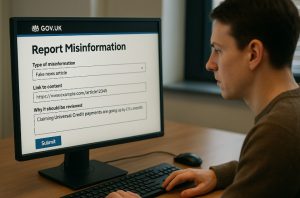
Misinformation can lead to confusion, frustration, and in some cases, financial harm. If you encounter misleading information about Universal Credit or DWP payments, it’s important to take action. This helps not only you but others who may also be misled by the same content.
Here are the appropriate steps:
- Report fake news or misleading posts on platforms such as Facebook, TikTok, or YouTube
- Flag inaccurate articles using the feedback or report tool available on most websites
- Inform others in your community or local support group about official sources of information
- Contact your local Jobcentre Plus or Citizens Advice if you’re unsure about a claim
Ensuring that benefit-related information is accurate is critical in helping individuals make informed financial decisions.
Conclusion
In conclusion, the rumored £325 Universal Credit payment for March 2026 is completely false and has not been confirmed by any official government body. While it is natural to hope for extra financial relief during tight times, claimants should always base their budgets on factual updates.
To stay safe from online scams and misinformation, keep an eye on your official Universal Credit online portal and rely only on verified announcements from the gov.uk website.
Frequently Asked Questions
Is the DWP issuing a £325 Universal Credit payment in 2026?
No, the DWP has not announced or confirmed any such payment; it is entirely an unconfirmed online rumor.
Where did the rumor about the £325 cost of living payment come from?
The rumor likely started on social media platforms like TikTok and Facebook by confusing or misinterpreting past 2022 government payments.
When was the last official DWP cost of living lump-sum paid out?
The final official cost of living installment was a £299 payment sent out to eligible claimants back in February 2024.
Do I need to apply or fill out a form to get this rumored £325?
No, because the payment does not exist. Be highly cautious of any texts or links asking you to apply, as these are financial scams.
What is the real Universal Credit standard allowance for a single person over 25 in 2026?
The official and verified baseline standard allowance for a single claimant aged 25 or older is £424.90 per month.
What is the 2026 Universal Credit rate for joint claimants where both are under 25?
For joint claimants who are both under the age of 25, the standard monthly allowance is set at £528.34.
Where can I find genuine emergency financial help if I am struggling?
You can apply for the Household Support Fund through your local council or request an interest-free Budgeting Advance directly via your DWP advisor.